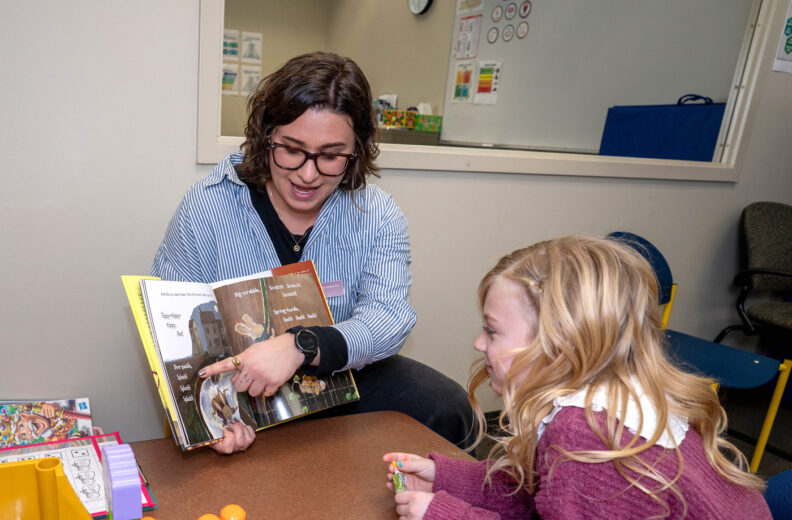
WSU Health and the Elson S. Floyd College of Medicine’s Department of Speech and Hearing Sciences are teaming up to support children who receive speech therapy over the school year but miss out on services during the summer.
The five-week program addresses a common gap for children who receive speech therapy through an independent educational program (IEP) during the school year but cannot access extended services over the summer.
“The majority of outpatient clinics have significant waitlists of six months or more, so during the summer, if parents want to access outside services, it’s not necessarily something they can pop into,” said program founder and Assistant Professor Ashley Winkle, MS, CCC-SLP. “We have the capacity to fill that need.”
The program—unique to WSU Health compared to other regional outpatient clinics—aims to help children maintain progress on communication goals and prevent regression during summer break. By working directly from each participant’s existing IEP goals, therapists can continue established interventions and provide continuous, targeted support.
“Consistency is key to student success,” said Mercedes DeMartini, MA, who joined Winkle in supporting the clinic this year. “Speech therapy practice is like playing the piano. Your skills will improve when used consistently.”
The Summer Gap Program offers individual sessions, incorporating targeted speech therapy interventions embedded in play-based activities, games, and worksheets. These tailored interventions are designed to meet each student’s goals and communication needs, expanding what’s possible in more generalized group settings.
“As clinical educators, it’s a really great way to connect back to why we are SLPs and clinicians in the first place,” Winkle said.
Parents and caregivers are also incorporated into the speech therapy process.
“We encourage parents to observe sessions directly or from an observation room,” Winkle said. “They can be more involved than they are able to be during the school year and learn more about what is happening and what we do.”
This gives parents rare insight into their child’s education. Winkle and DeMartini believe that helps them better understand therapy goals, support their child at home, and advocate more effectively.
“We are able to give parents resources, so they feel more confident in helping their child grow in their speech and language skills as well as support their self-advocacy for their children,” DeMartini explained.
The summer program also creates pathways for ongoing care with the WSU Health Speech-Language Pathology Clinic. Each year, a portion of students who participated in the summer sessions chose to continue receiving WSU services during the academic year in addition to their school-based support.
Both clinicians believe the growing interest in the program reinforces its value to the community.
“It’s something that’s needed in the community, and we have the space and opportunity to fill that need,” said Winkle.